PenWorks of the Word Blog Tour: Post 14 - Anna Moore Bradfield
Anna Moore Bradfield writes:
The Sponge and the Stick: What a Roman Toilet Taught Me About the Cross
I didn’t expect one of the most convicting moments of our trip to Turkey and Greece to happen at a public restroom.
My husband John and I recently traveled with Jonathan Cahn's Revelation Tour, walking through the ruins of the seven churches of Revelation. Among many other sites on that trip, we visited Ephesus. We stood where Paul preached, where a riot once shook a 25,000-seat theater, and where tradition says the apostle John dug his own grave. But the moment that stayed with me the longest happened at the ancient public latrines there.
A Very Public, Shared Experience
Our guide walked us through the daily life of the ancient city. We eventually arrived at the communal toilets. Communal. No kidding. No stalls for privacy. No place to wash your hands when you finished. Social by design. Imagine long stone benches with holes cut into them, positioned over a channel of running water, and you have an accurate picture.
The Romans held power then, over a huge span of territory that included Ephesus. Since they didn’t have toilet paper, they fashioned a simple tool that did the same job. It amounted to nothing more than a stick, with a sponge fastened on the end. They called it a tersorium. It was also communal. Just imagine. Someone would use it, rinse it in a trough of water or vinegar, and return it to its holder for the next one in line. Shared. Among strangers.
Our guide let that image settle. Then he said something that changed the way I will read the crucifixion account for the rest of my life.
The Sponge and the Cross
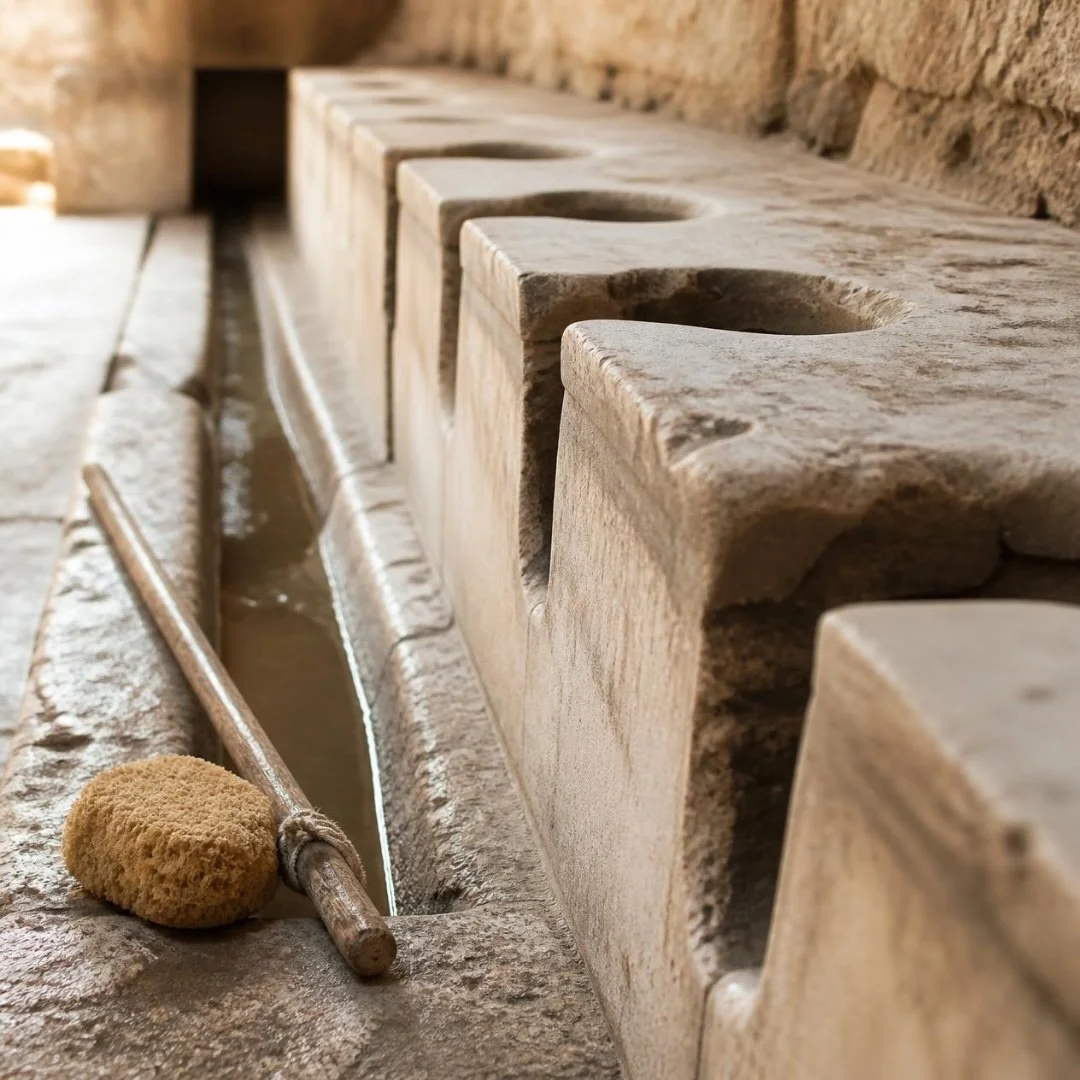
This element of the crucifixion scene was so profound that all four gospels reference it (Matthew 27:48, Mark 15:36, Luke 23:36, John 19:29). We’re no longer in Ephesus for these portions of Scripture but in Golgotha, just outside Jerusalem. Rome ruled there, too.
When Jesus said, "I thirst," Scripture tells us that a jar of sour wine sat nearby. Some might call it vinegar. Roman soldiers soaked a sponge in it. Then they fixed it to a branch of hyssop and lifted it to His lips.
A sponge. On a stick.
They repurposed the same crude instrument used in the latrines, immersing it in sour wine, and held it up to the mouth of a dying man. Our guide made no attempt to soften that detail. Rightly so. Whether the soldiers grabbed it out of convenience or handed it to Jesus as a final act of contempt, the symbolism is the same. This is what the world offered the King of Kings in His final moments on that cross.
As we stood in Ephesus, in the ruins of a city where a mob had once rioted for two hours rather than give up their idols, that image from Golgotha landed with a weight it never could have in a classroom or a church pew. This was the same place where people chose a goddess over a Savior. And now, here was the picture of exactly what that choice cost Him.
What’s the Lesson?
We naturally read the story and feel the horror and injustice of this cruelty. We may even swipe at a tear. But I think the real weight here isn't just historical. It's personal.
The question I grapple with when I think of the sponge and the stick isn't, "How could they do that to Him?" But rather, "What have I handed Him lately?"
We don't offer Jesus a literal sponge soaked in sour wine anymore. Yet we hand over our leftovers all the time—those exhausted, distracted, half-present versions of our attention after everything else has had first pick of our day. We offer Him convenience instead of devotion. Duty instead of love. We offer that thing closest at hand instead of our best. It isn’t so different spiritually from what happened at that cross. We hand over something ordinary and repurposed instead of a gift worthy of the Son of God.
How Do We Apply This?
Here's what I keep coming back to since that day in Ephesus:
What's "at hand" in your own life? When you turn to God in prayer, worship, or obedience, are you offering Him your first? Your best? Or are you handing Him whatever happens to be closest and most convenient at that moment?
Discomfort has its place. The image of the sponge is uncomfortable on purpose. Sometimes the most spiritually formative moments come from sitting with discomfort rather than rushing to explain it away.
Who are you offering this to? Jesus didn't spew accusations or judgments against those soldiers who lifted the sponge to him. He didn't demand better treatment in His final moments. He absorbed the worst that people offered Him—their indifference, their mockery, their convenience dressed up as cruelty—and still finished the work He came to do. So much more than a historical detail, that's the gospel encapsulated into a single moment in time.
What do you hand Him now? Not in the past, not someday, but today? Is it genuine? Is it all you have? Or is it whatever’s left over, after everything else gets your best?
John and I went to Turkey expecting to be moved by grand things. We dreamed of basking in what remained of ancient libraries, hearing our voices echoing in the massive theaters, and walking through the ruins of some of the greatest wonders of the world. Instead, a public toilet, along with a bit of Scripture I'd read a hundred times before, undid me.
Sometimes the smallest, strangest details in the Bible carry the greatest weight. It’s when we stop reading as spectators and start looking for the part we play in the story that we truly uncover those details and hear, maybe for the first time, what God has been trying to tell us all along.

Anna Moore Bradfield writes character-driven biblical fiction that explores the untold stories surrounding King David, bringing depth, emotion, and spiritual insight to the people Scripture only briefly reveals. Her series, The Lambswool Chronicles, invites readers into the lives behind the narrative—stories of faith, struggle, power, and surrender set against the backdrop of ancient Israel.
Readers describe her work as gripping, immersive, and hard to put down—stories that pull you in and don’t let go.
Follow Anna to stay connected with new releases and future stories from The Lambswool Chronicles
https://www.annamoorebradfield.com
Get, Liminal, Anna’s free prequel to her series, when you join her community https://BookHip.com/PHLJPSB